Showing posts with label Virender Sehwag. Show all posts

India's Squad for 2010 Asia Cup

There were a couple of regular names missing from the 2010 Asia Cup Indian squad announced and both caused a bit of a surprise.

While Sachin Tendulkar was reported to being rested, Yuvraj Singh was the biggest name dropped from the Indian team, the reins of which once again are held in the hands of Mahendra Singh Dhoni.

Those missing from the Zimbabwe ODI tri series return back into the team, all except Yuvraj Singh. R. Ashwin gets a chance and Pragyan Ojha is also a stand out name, although much deserved. The most notable addition is Saurabh Tiwary, adding pressure to Ravindra Jadeja amongst the young guns. Virender Sehwag returns to the Indian team to partner Gautam Gambhir as neither Murali ijay or Dinesh Karthik find place in the team. Rohit Sharma’s centuries in Zimbabwe have saved him the debacle of Yuvraj Singh. Also missing was Yusuf Pathan who failed to impress upon the selectors sufficiently to retain his place.

India’s squad for 2010 Asia Cup:
MS Dhoni (captain), Virender Sehwag, Gautam Gambhir, Virat Kohli, Suresh Raina, Rohit Sharma, Ravindra Jadeja, Harbhajan Singh, Praveen Kumar, Zaheer Khan, Ashish Nehra, Pragyan Ojha, Ashok Dinda, R Ashwin, Saurabh Tiwary

Source: http://www.crickblog.com/entry/india-s-squad-for-2010-asia-cup-announced/#ixzz0qJr1pvDq
Read More

Why Modi is like Sehwag

Lalit Modi
There's a correlation between a stable administration and a team's strong performance on the field, so is it then fair to compare the style of a player with that of an official?

The thought came to me following Virender Sehwag's highly amusing press conference in Chittagong where he claimed: "Bangladesh are an ordinary side. They can't beat India because they can't take twenty wickets."

Why all the fuss over his comments? After all he is correct. Sehwag was only being honest, which is the least you should expect from players and administrators. He was also being consistent; he's a straightforward, uncomplicated batsman so why would he be any different off the field?

As a batsman Sehwag is brilliant but frustrating. He can win a match in a session with scintillating strokeplay and equally drive his captain and fans to distraction by playing an indiscreet shot at an inappropriate moment. However, as the lyrics in Love and Marriage go: "you can't have one without the other". A captain can't gleefully hail Sehwag's scintillating performances when it results in victory and then castigate him for the odd indiscreet shot when it's detrimental to the team.

If we were to judge the flamboyance of administrators along similar lines, does that make Lalit Modi the Sehwag of officialdom?

Modi has had moments of brilliance interspersed with occasional lapses. His outstanding manoeuvres have resulted in IPL franchises, the IPL-Google deal and the BCCI's finances rising exponentially. On the debit side there have been his indiscretions in the USA during his student days and a rampant ego massaged by appearing more often on the IPL television coverage than the sponsor logo.

Modi is an administrator for the modern game. He's decisive and forward thinking. However, like Sehwag needs a steady opening partner to balance the combination, Modi requires a strong lieutenant to watch over him and temper his instinctive brilliance with a liberal dose of discipline.

With a number of international teams now bunched at the top of the rankings and sides being more aware of each other's ability through technology, one of the few remaining ways of gaining an advantage over opponents is to have a decisive and more flexible administration. This should apply to officials both at home and on tour.

And "decisive and flexible" certainly do not describe Pakistan's administration which is like the captain who is always at least a couple of overs behind the play.

It would have been preferable if Pakistan hadn't appointed Mohammad Yousuf captain in the first place. He has a temperament being weighed down, rather than buoyed, by the extra responsibility. However, having made the appointment and then found him wanting in the second Test, a vibrant administration would have considered replacing him swiftly. It couldn't have done any worse in a new appointment because following the SCG debacle, Yousuf was a dead captain leading.

Having seen that Yousuf would back off even before trouble reared its ugly head, the Australians couldn't wait for the next opportunity to attack Pakistan. They knew Yousuf was likely to succumb and he quickly obliged on the first day of the Hobart Test. That just confirmed his lame-duck status. And the Pakistan board reacted in the worst possible way.

With a number of international teams now bunched at the top of the rankings and sides being more aware of each other's ability through technology, one of the few remaining ways of gaining an advantage over opponents is to have a decisive and more flexible administration

Instead of making a bold move in an attempt to keep the team's hopes alive in the ODI series, it threw a lead-weighted lifebelt to a captain already up to his neck in quicksand. It retained him as the ODI captain and announced there would be a change in leadership when the team returned home. It couldn't have committed a bigger crime if it had backed Australia to win all five matches in the series. With the administration of both Pakistan and West Indies floundering, Cricket South Africa has made an interesting decision on the eve of the team's departure for the crucial Indian tour. It has decided to restructure the administration and as part of the process the coach has resigned and the selection panel has been sacked.

This move has the potential to replicate either a brilliant attacking masterpiece by Sehwag or the chaos of Inzamam-ul-Haq and Salman Butt gesturing at each other after having failed to complete an easy single. We'll soon know. If South Africa win the 2011 World Cup, instead of making an ignominious exit at the knockout stage, the decision will have a touch of Sehwag's genius.

Source & Picture: http://www.cricinfo.com
Read More

India seize advantage despite Mahmudullah heroics

Bangladesh v India, 1st Test, Chittagong, 3rd day

The Bulletin by Sidharth Monga
January 19, 2010
Mushfiqur Rahim
A brain freeze from the Bangladesh lower order squandered the initiative that a 108-run seventh-wicket stand had secured them. With Bangladesh throwing away their last four wickets and falling behind by one run, India didn't look the gift horse in the mouth and went on to extend that lead to 123 with nine wickets in hand.

From 98 for 6, Mahmudullah and Mushfiqur Rahim had carried Bangladesh past 200 when common sense deserted them. Mushfiqur, who had survived an edgy period early on, threw it away by slog-sweeping an innocuous-looking Amit Mishra from wide outside off. No. 9 Shahadat Hossain came out swinging like the climax of a Western, as opposed to giving the strike to Mahmudullah, who was already past his maiden Test fifty by then.

In the last over before tea, Shahadat chipped Mishra straight to cover. Back after the break, Mahmudullah smote the first ball for four, but when he lofted the fifth ball of the over over mid-on, he came back for two - any other settled batsman would have taken a single and seen out the whole of the next over. Under pressure to take a single next ball, he opened the face and edged Sreesanth to Dinesh Karthik. In the next over, Shafiul Islam got off the mark in Tests with a mowed six, but sliced the next ball to point. Just like that, a golden opportunity of keeping India in the field till about stumps had passed Bangladesh by.

They lost wickets in clusters: the last four for 36 runs, and the first six for 45. Of those six, three came early on the third morning. Zaheer Khan and Ishant Sharma continued from their impressive spells from the second day and the batsmen kept obliging. There was slight seam movement and bounce in the pitch, enough to make the batsmen regularly play down the wrong line.

Mohammad Ashraful was all at sea, playing Zaheer away from the body, and getting squared up by Ishant. The ever so slight holding of the line from Ishant, and a shade of extra bounce, was enough to awkwardly square up Ashraful and take the shoulder of the bat. Shakib Al Hasan looked to counterattack, hitting four boundaries in the next four overs. Again, all it took was a slight straightening of the ball, and a slash at a wide delivery was flying over gully when Virender Sehwag intercepted it perfectly.

When Zaheer and Ishant were taken off simultaneously, their partnership had resulted in five wickets for 59 runs, during the 23 overs they bowled on the trot. Sreesanth came back to end Raqibul Hasan's resistance, who too played inside the line of a straight delivery, and edged.

The seventh-wicket partnership stopped the procession of dismissals to outside edges and made India go wicketless for almost a full session, leading Bangladesh to a first-innings lead at the same time. Zaheer, the pick of the bowlers, struggled for support, with Sreesanth warned once for running on the pitch and over-stepping almost every second delivery. Mishra was not looking effective at all and Mahmudullah got stuck into him. Between them, Sreesanth and Mishra bowled 12 no-balls.

The duo didn't entirely abort the shots that had proved to be fatal for the earlier batsmen, but were slightly more sensible. They did get away with plays and misses to begin with, but when they chased the wide ones, soft hands meant the ball didn't fly towards slips. In fact, the third man area leaked eight boundaries.

The other big difference the two made was the running between the wickets. They ran hard, and they ran more often, which meant neither of the batsmen got stuck at one end for too long. Nineteen boundaries had been hit before the two came together and 14 came during their stand.

As the stand grew bigger, the batsmen grew surer. Mahmudullah started targeting Mishra, driving him through the covers, lofting him over mid-on, and paddling him to alternate the strike. But then, Bangladesh chose to display their lack of experience.

Coming into bat one run ahead, Virender Sehwag and Gautam Gambhir were more circumspect than in the first innings. They saw off the aggressive Shahadat without much adventure, and punished the other fast bowers, Shafiul and Rubel Hossain. With eight of their overs going for 55, Shakib had to bring himself on early again. By then, almost nonchalantly Sehwag and Gambhir had added 56 in 10 overs.

Sehwag stayed quiet against his first-innings nemesis for a bit, and had taken only five off 16 Shakib deliveries when he stepped out and launched him over long-on. Four balls later the slog-sweep against the turn consumed Sehwag. Sent in originally as nightwatchman, Mishra reversed roles, and got his own back at Mahmudullah, dancing down the track and lofting him over mid-on twice on the way to an unbeaten 24 off 21 deliveries. He subjected the other spinners to three other boundaries, taking his tally to one more than Gambhir's, who had seemed inconspicuous and yet scored 47 off 56. (www.cricinfo.com)
Read More

Shakib and Shahadat leave India reeling

Bangladesh v India, 1st Test, Chittagong, 1st day

The Bulletin by Sidharth Monga
January 17, 2010

Bangladesh, all pumped up and incisive, roared back "extraordinarily", taking eight Indian wickets for 130 runs and forcing Sachin Tendulkar to dig deep and try and take the visitors towards a respectable total. Shakib Al Hasan, who bowled 25 overs unchanged for 48 runs, and Shahadat Hossain, who bowled in hostile spurts, were at the centre of the comeback. The duo took four wickets apiece for 103 runs between them, and proved the Indians were "still human beings". Every wicket pumped Bangladesh up more and was met with wild celebrations. The special one was Shahadat's after Dinesh Karthik's wicket - a finger on his lips, telling his opponents in no unsubtle terms to watch their mouth.
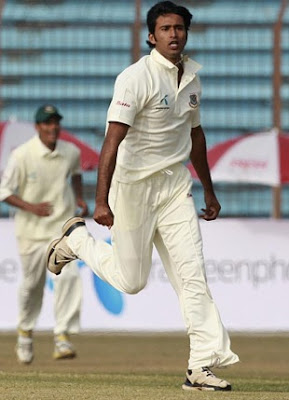
Shahadat Hossain
Virender Sehwag, who had called Bangladesh an "ordinary" side in the lead-up, got off to an aggressive start in a curtailed first session, after fog and murky light delayed the start of the match. When he went into lunch, despite the balls stopping and coming and the turn available for the spinners, Shakib would have wondered if he had made the right decision by putting India in. India had raced to 63 for 0 in 13 overs, and immediately after the break Sehwag hit Shahadat for three boundaries in one over, reaching his fifty at more than a run-a-ball.

Yet Sehwag wasn't totally in control. He had hit Shakib for a first-ball four, but the turn had Sehwag in an edgy frame of mind. During the 13 balls of spin he faced prior to his dismissal, Sehwag was forced to abort attacking shots because he was beaten in flight, rapped on the pads by arm balls, and had one bat-pad fly wide of forward short leg. He eventually lost patience and hit the 14th - a shortish delivery -straight to short cover. Shakib 1, Sehwag 0.

Sehwag's dismissal kickstarted a period of aggressive, smart bowling and captaincy, which eventually resulted in soft dismissals. Gautam Gambhir, who had been circumspect in playing outside off, went to cut a wide delivery from Shahadat and the extra bounce caught the edge. Rahul Dravid came to bat in a situation tailormade for him, but played all around a swinging yorker, and 79 for 3 became 85 for 3 in a matter of 17 deliveries.

Shakib kept his fast bowlers fresh by rotating them from one end, and upped the pressure by bowling himself unchanged until stumps. With Rubel Hossain getting reverse-swing from the other end, there were no free hits, boundaries were plugged away, and Laxman, especially, struggled to get off strike. For 13.4 overs there wasn't a single boundary.

Shakib mixed the offbreaks and the arm balls well, varying the degree of the flight as well. After a series of near dismissals - leaving alone an arm ball that almost shaved the off stump, hitting uppishly one bounce to short cover, and scoring 7 off 29 balls, Laxman finally over-balanced when looking to drive Shakib. The ball went straight on, took the inside edge onto the pad, and then rolled along to an alert Mushfiqur Rahim, who found Laxman short of his crease.

There was no counterattack forthcoming from Yuvraj, who prodded and nudged dangerously for 30 deliveries, before the lack of clarity of thought consumed him. Caught completely in the defensive frame of mind, Yuvraj could have done many things with a gentle leg-side fulltoss, but lobbing it down mid-on's throat wouldn't have been high on the agenda. Immediately, Shakib got Shahadat back, and as if on cue, Karthik drove at a wide delivery and edged low to gully.

All the batsmen who got out had a lesson to learn from the man they passed when they walked back. Tendulkar, dropped on 16 by Imrul Kayes at wide slip, respected that the pitch was not flat, Shakib and Shahadat were bowling really well, and cut out undue risks. He didn't play away from the body, worked the singles, found the gaps for twos, and even the edge that flew to the left of slip came against the run of play. Tendulkar capitalised on that, and without taking risks, maintained a strike-rate of 50-plus in reaching his 98th score of 50 and above.

The other end, though, remained vulnerable. The tea break came just at the right time, and Shakib and Shahadat came back fresh. Tendulkar and Amit Mishra added 32 for the seventh wicket, but Shahadat came back to produce a low, reversing full toss to Mishra. Unlike Tendulkar, Zaheer Khan couldn't make the most of a dropped catch, and the 27-run eight wicket ended when an arm ball got the latter.

Before bad light kept India's first innings fighting for another day, two statements were made that suggested that Bangladesh were not as ordinary as India had thought. Tendulkar was forced to try and farm the strike, and more often than not Shakib bowled smartly enough to keep him at the other end and expose the tailender for a complete over to Shahadat. And just before stumps, Shakib, not lacking in a sense of drama, bowled with three slips, a silly point, a forward short leg, and a leg gully to Ishant Sharma. (www.cricinfo.com)
Read More

'Bangladesh are an ordinary side' - Sehwag

Bangladesh v India, 1st Test, Chittagong

Sriram Veera in Chittagong
January 16, 2010

"Bangladesh are an ordinary side. They can't beat India because they can't take 20 wickets." That was Virender Sehwag's pre-series shooter on Bangladesh on the eve of the first Test in Chittagong.

You can never accuse Sehwag of being boring. His press conferences are as interesting as his batting. He sauntered in to the press room today, remained typically blunt throughout, dealt in monosyllables and left people speechless. The Indian journalists weren't so shocked because it was almost the norm with him; a few Bangladeshi journalists looked stunned.
Virender Sehwag

You could have said Sehwag was bordering on arrogance, you might have felt he was being dismissive, almost brutal especially in his assessment of Bangladesh' strengths and if you hadn't been in a Sehwag conference before, you certainly would have thought it was a slightly bizarre event. But it wasn't. It was in character. It was actually very funny but you could also see why some might take offense.

Bangladesh's response later on, in the form of Jamie Siddons and Shakib Al Hasan, was equally interesting. They weren't present at Sehwag's conference, of course, and reacted to the perceptions of the media who had listened to Sehwag.

A journalist asked the obvious question - can Bangladesh surprise India? "No. They can't beat us in Test matches," Sehwag said. "They can surprise you in ODIs but not in Tests."

Why? "Because they can't take 20 Indian wickets. Even Sri Lanka found it difficult. Bangladesh can't. They are an ordinary side."

There was not even an attempt at civility. There were no standard responses like "they are an upcoming side", "you can't take anyone lightly", or "they have some talented players." Nothing. He just saw the ball and hit it.

It's not as if Sehwag was even trying to be provocative. There certainly was no condescension, nor was it an act of trying to win any psychological points. It's how he has usually been addressing press conferences for some time now. And it certainly wasn't directed, at least solely, against Bangladesh.

Sample this.

"Where is Dhoni?" "He is taking a break". "Is he fine?" (The questioner wanted to know why he didn't come for the press conference). "He is enjoying himself. He is relaxing in the dressing room."

"What's your thought on the pitch?" "I haven't seen it."

Cue an awkward silence. It was a permanent feature of the conference. At one point, early on during one such period, Sehwag leaned forward and said, "thank you." Some laughed, some remained silent, some looked on quizzically and slowly more questions started to trickle. However, the answers continued to be fired with an impassive face and almost all questions were longer than the replies.

Siddons' and Shakib's conference too was awkward but for different reasons. Shakib didn't want to say anything on Sehwag but he said he doesn't consider India to be a true No. 1 Test side. "They are ranked No.1 recently but I think South Africa and Australia are much better than them," Shakib said. "It's true that they are playing well but they still are human beings and they will make mistakes."

Cries of "shabash, shabash (excellent, excellent)," went up from the back of the press room. It was certainly an interesting conference. It was Siddons' turn next. "Your thoughts on what Sehwag said?"

"He should stay away from mikes," Siddons said. "Every team has good and bad phases. His comments might bite him on his bum in a few years time. It might even hit him in the bum in a week's time. We are definitely not an ordinary side. That's what we are hoping to show in this Test series. We could hopefully prove Sehwag wrong."

Not many are convinced that the quality of the cricket in the series will be of high standard, but as Wally Hammond once so famously said at the start of an Ashes contest, what "a fine bloody way to start a series". (www.cricinfo.com)
Read More

India hold the edge on run-friendly pitch

India v Sri Lanka, 2nd ODI, Nagpur
The Preview by Jamie Alter
December 17, 2009

Match facts
Friday, December 18
Start time 14:30 (09:00 GMT)

The bowlers will head into Nagpur with the Rajkot run fest on their minds, but they won't get much relief from another hard track at the Vidarbha Cricket Association Stadium. India have the momentum and victory in Nagpur will give them a formidable 2-0 lead in the five-match series. Making it worse for Sri Lanka is the fact that they are down two bowlers. Muttiah Muralitharan and Dilhara Fernando have been ruled out for the series, meaning the visitors have two fresh faces, both potential debutants, which will not help a side aiming to level the series. It will take a huge effort for them to turn the tide their way on this surface.

The most alarming feature of the limited-overs leg of this tour has been the fielding of both sides; on what is believed to be another belter of a track, bowling straight and full and, most importantly, taking every chance will be paramount. The fast bowlers on either side were carted around for the first half of both innings in Rajkot, and the epidemic of spilling catches continued from the Tests and Twenty20s. Three catches and one half chance to Zaheer Khan went down, taking India's drop tally from three limited-overs games this past week to an even dozen.

For one side aiming to tighten their grasp on the series, and the other attempting to clutch a piece of it, wrapping their fingers around the key moments will be decisive.
Virender SehwagVirender Sehwag works on his bat ahead of the second ODI in Nagpur

Watch out for...

Mahela Jayawardene: Sri Lanka's former captain has experienced an unusual run of form in 2009 where he either gets a start and can't convert or falls early. In 23 innings this year, he has a century and three half-centuries; his next-highest score is 33 and three times he's been dismissed without scoring. The law of averages says it's about time for a century, but it will be against a side off which he has only one hundred in 55 innings. To do so, Jayawardene will need to get over his struggles against India's spinners, who have now dismissed him five times - six if you count the run out in Rajkot during a Ravindra Jadeja over - from his seven ODI innings against them in 2009.

Gautam Gambhir: He's been India's most consistent Test batsman this year but his figures aren't so hot in ODIs. His only century came against Sri Lanka in the first week of February and since then Gambhir has managed four half-centuries. For a determined player, who has made a superb effort to convert fifties into centuries in Tests, changing a habit that hampered him for some time, doing the same in ODIs must be a goal. Given the nature of the Nagpur track - India eased past 350 runs when they played Australia here in October - it is tough to visualise one of the top three not getting a big score. Gambhir has been able to bat at the top in only ten of 20 innings in 2009; if he gets the chance to bat at No. 3 tomorrow, count on a significant innings.

The batting Powerplay: This five-over block turned out to be a bit of a worry for both sides. In Rajkot, India seemed on course for 450 before they lost Sehwag, MS Dhoni and Gambhir while scoring just 33 runs during their batting Powerplay, taken after 34 overs. Sri Lanka opted for theirs at 291 for 1 after 35 overs and scored 21 runs off the first over, but managed 32 for 3 from the next four. And that was where the match turned.

Team news

Yuvraj Singh is almost ruled out - he has the flu, in addition to his finger injury and missed practice on Thursday - but Sehwag has been cleared to play after picking up a knee injury in Nagpur. The batting will remain the same as the first ODI, though Sudeep Tyagi may just fancy a debut ahead of Praveen Kumar.

India: 1 Virender Sehwag, 2 Sachin Tendulkar, 3 Gautam Gambhir, 4 MS Dhoni (capt & wk), 5 Suresh Raina, 6 Virat Kohli, 7 Ravindra Jadeja, 8 Harbhajan Singh, 9 Praveen Kumar/Sudeep Tyagi, 10 Zaheer Khan, 11 Ashish Nehra.

Apart from the injuries to Murali and Fernando, Sri Lanka also had to sweat on Lasith Malinga's fitness. He missed the first match and the management will be hopeful of his return to replace Fernando. If not, it could mean a debut for rookie fast bowler Suranga Lakmal, who teamed up with the squad today, or a spinner coming in. If it is the latter, Ajantha Mendis remains the safe bet but one of Muthumudalige Pushpakumara or Suraj Randiv could debut.

Sri Lanka: (probable) 1 Upul Tharanga, 2 Tillakaratne Dilshan, 3 Kumar Sangakkara (capt & wk), 4 Mahela Jayawardene, 5 Sanath Jayasuriya, 6 Thilan Samaraweera, 7 Thilina Kandamby, 8 Angelo Mathews, 9 Nuwan Kulasekara, 10 Chanaka Welegedara/Ajantha Mendis/ Muthumudalige Pushpakumara, 11 Lasith Malinga/Suranga Lakmal.

Pitch and conditions

This will be only the second one-day international played at this venue - the first was a run fest. India racked up 354 against Australia and then won by 99 runs. The pitch is expected to be conducive for run-making, as it was during the Twenty20 when Sri Lanka made 216 in 20 overs. Scattered showers are forecast by the weather bureau, with temperatures of 27C predicted.

Stats and trivia

* Virender Sehwag, during the course of his 102-ball 146, was most severe on Angelo Mathews, plundering 27 runs off 10 balls.

* Harbhajan Singh was India's best bowler in the face of an onslaught from Sri Lanka's top order. It showed in his figures against centurion Tillakaratne Dilshan: in 26 balls bowled to Dilshan, the batsman only managed 17 runs. (www.cricinfo.com)
Read More